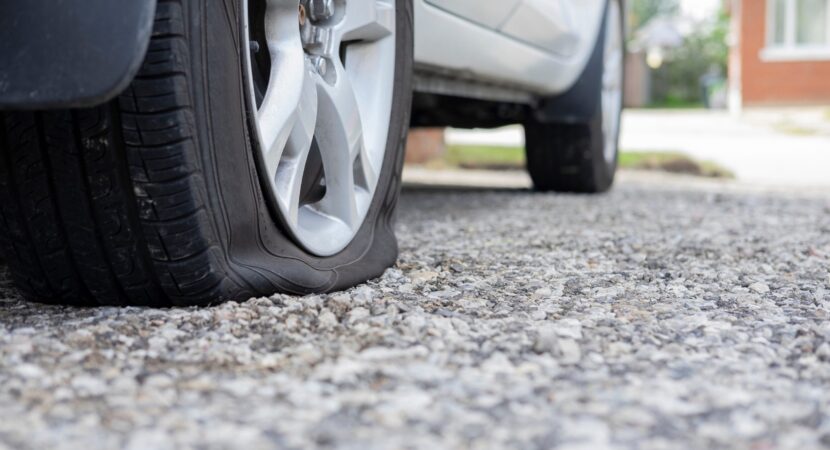
A nail in the tire does not always mean you need a new tire—but some punctures cannot be repaired safely. For drivers in Asheville, Black Mountain, Weaverville, Fletcher, Canton, and across Western North Carolina, the right decision depends on where the damage is, how large it is, the tire’s condition, and whether it has been driven while underinflated.
The safest first step: if a tire is losing air quickly, looks damaged, or feels unstable, slow down carefully and stop somewhere safe. Do not keep driving on a flat or nearly flat tire to reach a shop. Driving underinflated can damage the tire internally and may make an otherwise repairable puncture unsafe to fix.
When Can a Flat Tire Be Repaired?
A trained tire professional may be able to repair a tire when the puncture is small, located in the repairable tread area, and the tire has no additional damage. Industry guidance generally limits eligible punctures to the tread area and to no more than 1/4 inch (6 mm) in diameter. The tire must also meet the tire maker’s repair requirements.
A puncture from a nail or screw near the center of the tread may be a candidate, but appearance alone is not enough to decide. A technician needs to remove the tire from the wheel and inspect the inside for hidden damage, including damage caused by driving while underinflated.
The U.S. Tire Manufacturers Association’s tire repair guidance explains the key limits and inspection requirements. If the damage falls outside those limits, replacing the tire is usually the safer option.
When Should a Tire Be Replaced Instead?
Repair is not appropriate for every flat. A tire professional may recommend replacement if any of these conditions apply:
- Damage to the sidewall or shoulder: These areas flex heavily while the tire rolls and are not considered repairable for ordinary puncture repairs.
- A puncture that is too large: Damage greater than about 1/4 inch (6 mm), or damage that is irregular or torn, is generally outside standard passenger-tire repair limits.
- Damage near the edge of the tread: A puncture close to the shoulder may extend into a non-repairable area.
- Internal damage: Driving on a flat or severely underinflated tire can cause internal structural damage that may not be visible from the outside.
- Existing improper repairs or overlapping injuries: Previous damage or repairs can make a safe repair impossible.
- Very worn tread or other serious damage: A tire at the treadwear indicators, with exposed cords, deep cuts, a bulge, or other structural damage should not be treated as a routine puncture repair.
If you see a sidewall bulge, review our guide on tire sidewall bulges and why they are dangerous. A bulge is a warning of possible structural damage, not something a patch can safely fix.
Why a Plug Alone Is Not a Proper Permanent Repair
A quick external plug may look like a simple solution, but it does not provide the complete inspection and repair used in accepted tire-repair procedures. Industry guidance calls for removing the tire from the wheel, inspecting the interior, filling the puncture channel with a suitable rubber repair stem, and sealing the inner liner with a patch or an approved combination repair unit.
A patch alone also does not fill the puncture channel. Ask the service provider whether the tire will be demounted and inspected and whether the repair follows the tire manufacturer’s requirements. Temporary sealants or emergency inflators can be useful in certain situations when the vehicle maker allows them, but they should not be assumed to be a permanent repair. Follow the product and vehicle instructions and arrange a professional inspection.
For more detail, see the Tire Industry Association’s tire repair guidance.
What to Do If You Get a Flat on an Asheville-Area Road
- Stay calm and reduce speed gradually. Avoid abrupt steering or hard braking if the vehicle begins to pull or vibrate.
- Move out of traffic when it is safe. Choose a stable, well-lit location away from moving vehicles if possible. Do not stop in a travel lane to inspect the tire unless you have no safer option.
- Turn on hazard lights. Follow your vehicle owner’s manual for the safest response and use roadside assistance if you cannot reach a safe location.
- Do not crawl under a vehicle supported only by a jack. Changing a tire beside traffic or on soft, sloped ground can be dangerous. If conditions are unsafe, wait for professional help.
- Check your vehicle’s options. Some vehicles have a spare, others have a mobility kit, and some have run-flat tires with specific driving limits. Follow the owner’s manual rather than guessing.
If the tire is completely flat, has a visible sidewall injury, or the vehicle does not handle normally, do not continue driving just because the destination is nearby.
Can You Tell From the Outside Whether a Tire Is Repairable?
Not reliably. You may see a nail or screw in the tread, but you cannot tell from the outside whether the tire has internal damage or whether the puncture reaches the shoulder area. Do not pull an embedded object out just to see what happens; it may accelerate air loss. A technician needs to assess the tire, its inflation history, tread condition, and the puncture location.
Keeping tires properly inflated can help reduce avoidable tire stress. Check pressure when tires are cold and use the recommended PSI on the driver’s door-jamb label or in the owner’s manual. Our guide to checking tire pressure correctly explains how to find the right specification.
Flat Tire Help in Asheville and Western North Carolina
If you have a flat or discover a puncture, contact ACO Tires & Detailing to discuss the safest next step and available tire-service options. Mobile tire service can be convenient when a tire needs attention at home or work, and the Asheville shop is another point of contact. Availability depends on the vehicle, location, and type of damage; a tire that is unsafe to drive should not be driven to the shop.
- Website: acotires.com
- Phone: 828-338-2206
- Address: 2 Shagbark Dr, Asheville, NC
Whether you’re in Asheville, Black Mountain, Weaverville, Fletcher, Canton, or another nearby community, do not assume every puncture can be plugged—or that every flat requires a new tire. A qualified inspection is the best way to determine whether a repair is appropriate or replacement is the safer choice.